

Ginans (devotional songs in Indian languages) are the basis and foundation of Ismailism. Disputing the preaching of a Ginan by a Ismaili would be similar in significance to the contradiction of the teachings of the Quran by a believing Muslim. Any study of the Ismaili Tariqah, without the study of the origins of Ginans and their influence upon Ismailis, would be an incomplete study.
Who Wrote The Ginans?
Forefathers of the present day Khoja Ismailis were converted by Pirs (پیر) from Hinduism with the Ginanic preaching.
“Pir” is a Persian word. It means Murshid, Guru, an authorized teacher. For a Ismaili, the teachings of a Pir are to be obeyed, word for word.
Al-Waez Abualy A. Aziz has quoted a Farman of an Imam on Page 134 of ‘Ismaili Tariqah’ to show that the obedience to Pir is obligatory upon every Ismaili. The quoted Farman reads:
“The Pir is the person to whom the Imam of the time has granted his position which makes him the highest amongst his creation (ashraf-imakhluqat) and whenever the Imam has chosen the Pir and appointed him, he must convey to others the knowledge in detail. You must attain perfection in the knowledge of the Imam through him. Therefore it is obligatory upon you to follow the Pir, never flinching from his obedience. Be bound by what the Pir tells you, acting as he says and when you obey the Pir, the Pir in the Hereafter will pray to God for your protection”.
Ismailis recite Ginans everyday with love and devotion in their Jamatkhanas, but most Ismailis have not studied the History and origin of these Ginans. They believe that each and every Ginan that is recited in their Jamatkhanas and/or published by the Ismailia Association is composed by an authorized Pir and must be obeyed. However that is not so. In fact, there are more Ginans composed by non-Pirs than there are by Pirs.
Appointed Pirs and Their Children
Al-Waez Abualy A. Aziz writes on pages 134 and 135 of his book ’Ismaili Tariqah”:
“The children of our Holy Pirs were also respectfully called Pirs. They were not the Appointed Pirs as Hujjatul Imam but they were dais, missionaries. They were Sayyids. There is nothing wrong to call these children of our Holy Pirs as Pirs. Our Pirs and their children composed the Ginans in various Indian languages. The present collection of our Ginanic literature is the work of our ten Appointed Pirs and more than twenty of their children. Bhagat Kara Ruda said that more than forty Sayyids among the children of our Holy Pirs, particularly the children of Pir Sadruddin and Pir Hasan Kabirdin, had composed thousands of Ginans, most of which were lost with time”.
Ginans Authored by Anonymous Authors
Professor W. Ivanow, a well known Russian scholar and a reputed researcher of Ismaili history has translated many books and manuscripts of Ismaili literature. He writes in his book ‘Ismaili Literature’ (Tehran University Press – 1963) on Page 174:
“A great majority of Ginans are the creation of anonymous authors. Apparently quite a considerable proportion of those attributed to the authorship of Great Pirs probably have nothing to do with them, and were composed at a much later date. This particularly applies to the gnans about various Pirs, their miracles, their sayings”.
Hundreds of Ginans which were composed by the children and grandchildren of the pirs were attributed to Pir Sadruddin and Pir Hasan Kabirdin by these descendants. Writing new Ginans and selling them to newly converted Khojas was the main source of income for these hundreds of relatives of Pirs. Ismailia Association for India has confirmed these facts and added that “out of 18 sons of Pir Hasan Kabirdin, 17 sons had opened various religious Bazaars of their own and had started their own independent factories. Some of these so called Sayyids had even established their own sects.
In 1969, the Ismailia Association for India published a series of Collection of Ginans (2nd Edition). This series includes Ginans composed by officially appointed authorized Pirs, Ginans by Sayyids (descendants of the Pirs) whose names and brief history are published in the introduction, and also Ginans composed by so-called Sayyids, whose historical record is neither available, nor known.
Below are three excerpts from the introductions of this series published from Bombay, India by the Ismailia Association:
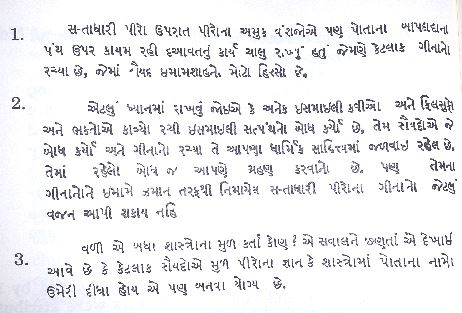

Translation:
1. Besides the authorized Pirs, descendants of the Pirs have also propagated faith in the same manner as their fathers and grandfathers. These descendants have composed some Ginans in which Sayyid Imamshah’s contribution is the greatest.
2. It should be borne in mind (by Ismailis) that many Ismaili Poets, Philosophers and Bhagats (devotes) have written songs and propagated the true path of Ismailism. Similarly Sayyids (and one Sayyidah) have also composed Ginans and propagated the faith. These compositions have been preserved in our religious literature. We have only to adopt the preaching that are within these compositions (Ginans). But, the Ginans of these composers cannot be given the same “weight” as those composed by the authorized Pirs that were nominated by Imam-e-Zaman.
3. Who were the original creators (composers) of all these sacred writings (Ginans)? In trying to find an answer to this question it is being observed that it is likely that some Sayyids (descendants of Pirs) might have added their names to the original Ginans or sacred writings created by Pirs.
It is evident from the last excerpt that the Ismailia Association is trying to impress upon Ismailis that although a Ginan may mention the name of a Sayyid or Sayyidah as the composer it could be a composition of an authorized Pir. In other words, it should be given the same “weight” as an authorized composition. The collection of “Ginans” published by the Ismailia Association for India is made from the following categories:
1. Authorized Ginans composed by appointed Pirs
2. Devotional Songs composed by known Sayyids
3. Devotional Songs composed by unknown Sayyids
Officially, Ginans and Songs are both called Ginans. Both are being equally honoured, trusted and obeyed by Ismailis, because they bear the same nomenclature. In some cases the name of a father appears as the creator Pir and his son’s name appears, in the same verse, as the reciter Pir. There are even cases where the prefix ‘Pir’ is added to the name of the composer when he is neither a Pir nor a descendant of any Pir or Sayyid. Below is one such “Phony Ginan” created during my lifetime.
About The Phony Ginan “Par karo beda Guruji”
A Ginan which begins with “Par karo beda Guruji” is often being recited in the Jamatkhanas of Canada. It is a “song” composed by Head Master (Head Teacher) Hussain Gulamhussain Hussaini of a religious night school at Khadak, Bombay, India in the 1940’s. In those days I was one of the teachers in that school. The Head Master had a poetic talent and used to compose songs for students of the night school to sing in the night school “Majlis”. Later on, this particular song became a “Ginan”. Master Hussaini who had composed the song, under the pen-name of “Musst” (in high spirits – carefree),
became ‘Pir Musst Musst Hussaini” instead of ‘Musst Master Hussaini”. The majority of Ismailis do not know such historical facts behind the origin of Ismaili Ginans. A missionary would not reveal these facts, in order to preserve the “weight” of Ginanic literature. They want Ismailis to obey each and every “Ginan” with the same respect in spite of the fact that there are more unauthorized Ginans than there are authorized ones.
Who wrote “Garbis” of Pir Shams?
Ismaili sources record that Pir Shams was sent to India by one of their Imams from Iran. He was born in Iran. He died in Multan, Pakistan (formerly India). The custodian of the shrine in Multan has a genealogy tree (Sajrah) which records that he was born in Gazhni and came from Afghanistan. He was not an Ismaili and he did not propagate the Ismaili faith. However, the point to note is that he was a foreigner when he came to India. History records that he traveled from Afghanistan to Sind, Punjab, Kashmir and Tibet and settled in Multan (Punjab) where he died. Even the Ismaili sources have no records of his stay in Cutchh, Kathiawar or Gujrat where the inhabitants speak Gujrati.
In the Jamatkhanas of Punjab, Ismailis recite Ginans in Punjabi which they say were composed by Pir Shams, seven centuries ago. In most of the other Jamatkhanas the world over, Ismailis recite Garbis (folk songs in Gujrati to which men and women would dance at a festival, with music), Kathas, Salokas and Ginans in Gujrati which they claim were all composed by Pir Shams. This entire collection in Gujrati language would be of over 2000 verses.
This gives rise to a series of questions:
1. When and where did Pir Shams learn Gujrati?
2. Why would he compose and sing Ginans in Gujrati before his non-Gujrati adherents?
3. Was the art of poetry writing in Gujrati already developed 700 years ago?
Examining the standard of the language of the Garbis and Ginans by Pir Shams, one can say that they are the work of an individual well versed in contemporary as well as medieval Gujrati.
Who edited “Pir Pandiyat-i Jawan-mardi”?
It is interesting to note that in the Ismaili Tariqah, one of the “Authorized Pirs” is a “Book”. The Book is supposed to have been written by a Nizari Imam whose name was called Mustansir Billah II. The Book is called ‘Pir Pandiyat-i Jawan-mardi” – a strange name for a Pir. For more details please read page 123 and 124 of ‘A Brief History of Ismailism’ by Abualy A. Aziz.
Professor W Ivanow translated “Pir Pandiyat-i Jawan-mardi’ into English and published the text of the work and its translation through ‘The Ismaili Society’, Bombay, in 1953. Ten years later he wrote:
“Taking into consideration the fundamental differences between various versions of the text, mentioned in the Introduction, it is easy to suspect that the work (Pandiyat-i Jawan-mardi) has passed through the hands of Khayrkhwah (Herati) who had no scruples about ‘editing’ it, and probably ultimately it reached India in his version”.
‘Ismaili Literature’ Tehran University Press, 1963. Page 139
Who wrote “Kalam-i Pir”?
Khayrkhwah Herati is also suspected by Professor Ivanow of committing ‘the worst plagiarism” and converting “Haft-bab-i Bu Ishaq” (Haft-bab written by Abu Ishaq Quhistani) into “Haft-bab-i Shah Sayyid Nasir” (Haft-bab written by Sayyid Nasir-i Khusraw), otherwise known as “Kalam-i Pir“. This book is considered as “Pir”, by Ismailis of Badakshan and Northern Pakistan. It has also been translated by Professor W. Ivanow into English in 1959.
“Editing” of books written by Pirs and Imams is not an uncommon practice in this Unique Tariqah. The “edited” version is treated with the same veneration and glory as if it was the original unedited version, because an Ismaili cannot distinguish the edited portion from the unedited.
Who made “w’Allah” (“By God!”), into Allah?
Over a period of seven centuries, the original Ginans have gone through lots of transitions. Most of the old Ginans have either been lost or removed from circulation permanently In their places new Ginans have been added. Ginans were composed by Sayyids (male and female) until the last century.
Many Ginans have been edited by the Ismailia Associations.
Some Ginans are banned by the Imams.
Others have been modified or recast to incorporate Shia beliefs or to glorify the image of Ali. For example, the word “Hari” has been replaced with “Ali”, “Swami” is changed to “Sami’ and “w’Allah e’hi Imam” meaning “By God! that (Islam Shah) is Imam” has been altered to read “Allah e’hi Imam” meaning “Allah that is (equal to) Imam”, (nauzbillah).
The texts of some of these Ginans are beyond human reasoning and logic. Yet, in spite of these corruptions, Ginans are the basis of Ismaili beliefs. Ismailis burst with joy and pride when they sing “Allah e’hi Imam” not knowing that they are uttering a blasphemy and committing a heinous sin.
On pages 136 and 137 of ‘Ismaili Tariqah’ Abualyhas quoted nearly a dozen or so Farmans of Aga Khan III on Ginans. Reproduced below are three Farmans:
“Pir Sadruddin composed the Ginans, in Indian languages, which are the extracts from the Quran” – Aga Khan III
“Pir Sadruddin has given you, in his Ginans, the tafseer (interpretation) of the Quran-e-Shariff”. – Aga Khan III
“Pir Sadruddin has guided you to the Right Path. If (instead) you will follow the path of the Moguls and the Arabs, you will be lost”. – Aga Khan III
Prophet Muhammad came to India as “Pir”
On page 133, Abualy has quoted a Ginan of Pir Sadruddin in Gujrati and has given the translation thereof as under:
Translation:
“Before the creation there was Nabi Mohammed Mustafa. The same Murshid has come to India.”
Such fantastic claims made in the names of Pirs are the basis of the Ismaili Tariqah’s bizarre teachings and beliefs of the repeated incarnations of Hazrat Ali (ra) and Prophet Muhammad (pbuh) as the ‘Avtaras‘ of Hindu deities; ‘Vishnu’ and ‘Bramah’ respectively, from before the Creation. Ismailis are also taught that the Pirs who came to India were the holders of the Noor of Prophet Muhammad (pbuh) – the Bramah, and the Aga Khans are the final Avtaras of Lord Vishnu. Rama and Krishna were also Avtaras of Vishnu.
Prophet acknowledged Ali was the Creator
Quoted below is another “Unique Ginan”. The Ginan is published under a collection entitled “Momin Chetavni“. This Ginan is in connection with the birth of Ali ibn Abu Talib. It narrates a dialogue between Muhammed Mustafa (who was not yet Prophet and was 29 years of age) and a group of Angels who had come down from heaven to see Ali ibn Abu Talib, who had just been born.
Translation:
‘When Nabi Muhammed, the leader of the Angels, returned after doing his Salaam (to Ali), the Angels said to Nabi Muhammed
“He (Baby Ali) is the creator of ‘Arsh Kursh’ (Heavenly throne);
He (Ali) is the one who has commanded us and kept us under your leadership.
He is indeed the same, without any doubt.
Then Nabi Muhammed replied:
“Brother Angels, let me tell you my thoughts; He (Baby Ali) has made known to me, he is the Creator of this Universe”.
Can these Ginans be considered as the “extracts from the Quran”? Does the Quran speak of “Ali the Creator of this Universe”?
No Muslim in his right mind would believe a single verse of the above Ginans. Any individual (Muslim or non-Muslim) who has read the history of the Great Prophet of Islam would say that when the Prophet Muhammad heard Angel Jibrael (Gabriel) for the first time in his life, it was in the cave of Mount Hira and he being about 40 years old. If the Prophet at the age of 29 years knew “Ali is the Creator of this Universe” then why did he go to Mount Hira? Why was the Prophet shocked to hear the voice of Angel Jibrael in the cave, if they both had known each other and spoken before? Finally, who told the Pir what the Prophet said to the Angels 700 years ago? Such Ginans are the basis for establishing the “Unique Supremacy” of Ali and his successors, the Aga Khans.
Allah created Adam and gave him wisdom. He implanted in him the faculty of knowledge and judgment, before sending him upon this earth. He also gave him the power of reasoning, intuition and instinctive feelings. He therefore enjoys a special place within the creation of Allah – “Ashraful Makhlukat“. Allah has honoured Adam to be His vicegerent on earth – “Khaliful Ardh“. We, the human race, inherited these faculties. Today, the sources of acquiring knowledge are unlimited and easily accessible. This makes one wonder why Ismailis of this 20th century who are so advanced and discerning in managing their financial affairs, become so gullible as to place their entire confidence in Ginans, and base their religious beliefs on such bizarre Ginanic legends of Ali and Nabi and not upon the Quranic teachings?
The Quran teaches: “Say I (Muhammad) am no more than a human being like you”. Holy Quran 18/10
As for the supremacy of Hazrat Ali; in the Fatimid period (i.e. pre-Alamut and preGinanic period), Ali was considered as “al-Wasiyin wa Wazir Khair al-Mursalin”, meaning “the distinguished Nominee and Representative(Wazir) of the Messenger”. These words were inscribed on the obverse of the Fatimid Dinars to describe their Imams – the descendants of Ali.
Should not the Aga Khan ask his followers to consider him, ‘Wazir of the Messenger’, since he claims to be a descendant of the Fatimid Imams?
Who are Moguls and Arabs?
Incidentally, there is another Farman of Aga Khan III which speaks of Moguls as being “beggars” and Arabs “like donkeys’ and “what will they teach Ismailis?” The Farman is in “Khojki” (a script especially developed by Khoja-Ismailis, for private records and secret writings). This Farman was made on August 20, 1899 in Zanzibar, Africa, the translation of which is as follows:
“Pir Sadardin has shown you the straight path, if you leave that, and walk upon the talks of Moguls and Arabs, then you will fall down. Arabs are like donkeys. What will they teach you? They themselves do not know anything, then what will they teach you? Moguls seek alms in every country. What will they teach you? If you follow their talks, then you too will become donkeys”. (Bahere Rehmat, pages 30 & 31)
Aga Khan III tells Ismailis in the Farman that if they follow the words of Moguls and Arabs they will fall down and become like donkeys. The question is, who was Aga Khan III? Did he not call himself a Hashemite? Who were Hazrat Ali (r.a.) and Nabi Muhammad (s.a.s.)? Finally, who is Aga Khan IV? Is he Italian, French, British, Irani or an Arab? He calls himself Karim al-Hussaini. Who were Hashem and Hussain, if not Arabs?
Muslims – those who submit to Allah – have based their religious beliefs by reference to the “Words of their Creator” – the Quran. Ismaili Momins – those who submit to their Imams – have based their religious beliefs by reference to the “words of Poets” – the Ginans. Which Tariqah is on the right path? Allah says:
Shall I inform you upon whom the devils descend?
They descend upon every sinful liar.
They pass on what is heard, and most of them are liars.
And the poets – [only] the deviators follow them;
And that they say what they do not do?
[Holy Quran Chapter 26, Ash Shuraa, Verses 221 – 226]
Credit: The above is an excerpt from our most-downloaded book, “Understanding Ismailism“. Get your free copy from the English Downloads section on our site or by clicking here.