
Nizari Ismailis recite the Ismaili Holy Du’a (called Du’a) instead of the Muslim prayer (called salāt in Arabic and namaz in Persian and Urdu). In Urdu-speaking countries, Ismailis insist that since the word namaz does not appear anywhere in the Quran, the namaz which is recited by the Muslims is never commanded by the Quran and that the Ismailis are free to call it Du’a since it is one of the meanings of the Arabic word salāt.
Beyond just the word, the Du’a offered by the Nizari Ismailis is not anything like the Muslim salāt which the Prophet (pbuh) used to offer and which Muslims to-date have learned and practised. Not only did the Prophet (pbuh) offered the Muslim salāt, he also instructed us:
“Pray as you have seen me praying.” (Sahih Bukhari Book 1, Vol. 1, Hadith #604)
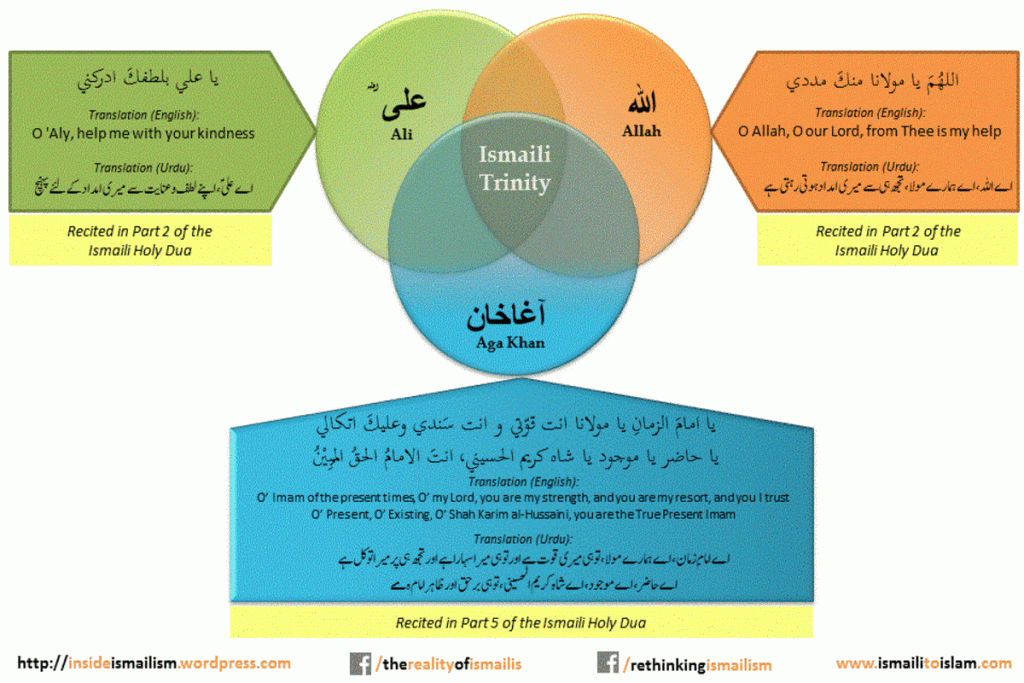
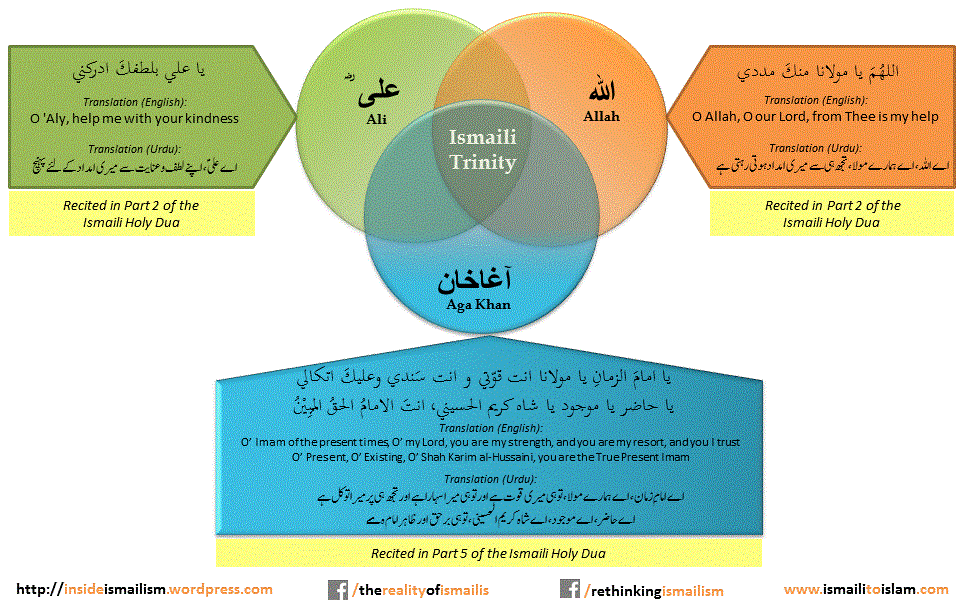
Other than being different than the Muslim salāt, a deeper inspection of this Du’a reveals many aspects of Ismailis’ own version of Trinity. Daily recitation of this Holy Du’a subliminally minimizes the difference between Allah (swt), Ali (ra) and Aga Khan since the Ismaili worshiper invokes all three during his prayer thinking that he is invoking a single deity.
1. Fixed Form of Nizari Ismaili Holy Dua
The Muslim salah begins with the mandatory recitation of Surah al-Fatiha followed by a recitation of any verse(s) or chapter(s) from the Quran, followed by ruku (bowing) and sujud (prostration). There is no option on the Ismaili worshiper to recite any Chapter of the Quran – the content is fixed and contextually, the Ismaili Holy Dua is directed towards Allah – or is it? We shall examine this in the later part of this article.
2. Triple Invocation
2.1 Triple Invocation #1 (of 3): Invoking Allah (swt) as Ya Mowlana
As claimants of being members of the Muslim Ummah, the Ismailis invoke Allah in their Holy Dua as do more than a billion Muslims around the world. They address Allah as Ya Mowlana.
In Unit 2 of Ismaili Holy Du’a, it is recited:
اللهمَ يا مولانا انتَ السَّلامُ وَ مِنكَ السَّلامُ
Transliteration:
Allahumma ya mawlānā antas-salam, wa minkas-salam,
Translation (English):
O Allah, O our Lord, Thou art the peace, and from Thee is the peace.
Translation (Urdu):
اے اللہ، اے ہمارے مولا، تو ہی سلامتی ہے اور تجھ ہی سے سلامتی لوٹتی ہے
Here is an excerpt from the Ismaili Dua book as an evidence of the above:
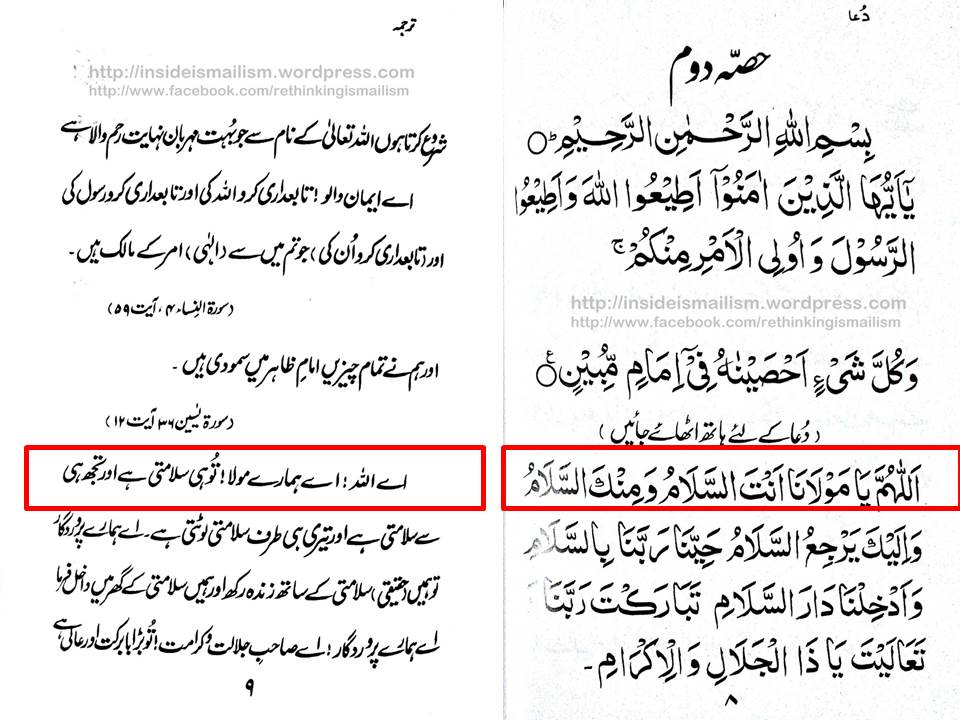

Ismaili Holy Dua Pages 8-9
In the same Unit 2 of the Holy Dua, the Ismaili worshiper recites:
اللهُمَ يا مَوْلاَنا مِنكَ مَدَدِي
Transliteration:
Allahumma ya mowlana minka madadi
Translation (English):
O Allah, O our Lord, from Thee is my help
Translation (Urdu):
اے اللہ، اے ہمارے مولا، تجھ ہی سے میری امداد ہوتی رہتی ہے
Here is an excerpt from the Ismaili Dua book as an evidence of the above:
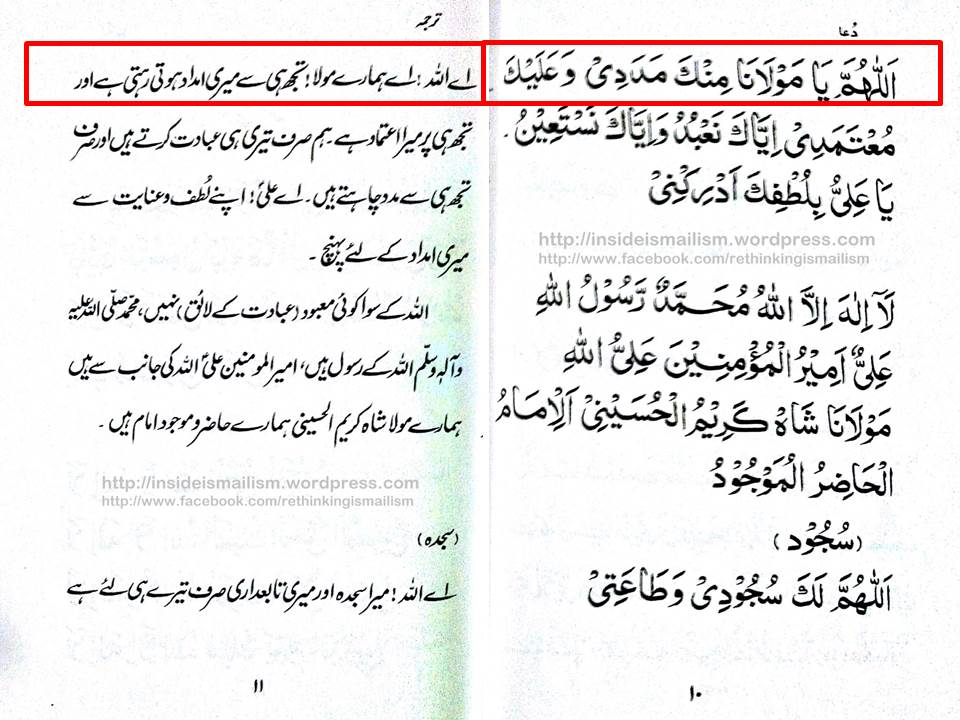

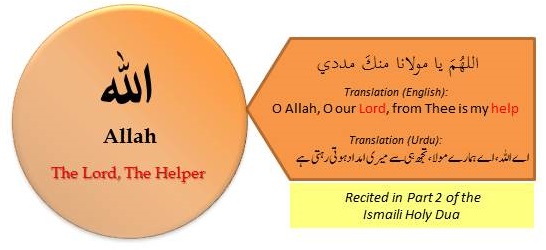
The above therefore establishes that Allah (swt) is invoked, and equated to Mawla, and is asked for help (مدد), which can be illustrated as follows:

2.2 Triple Invocation #2 (of 3): Invoking Ali (ra)
In Unit 2 of the Holy Dua, the Ismaili worshiper invokes Ali (ra) instead of Allah (swt) by saying:
يا علي بلطفكَ ادركني
Transliteration:
Ya ‘Ali Bilutfika Adrikni
Translation (English):
O ‘Aly, help me with your kindness
Translation (Urdu):
اے علیؑ، اپنے لطف و عنایت سے میری امداد کے لئے پہنچ
Here is an excerpt from the Ismaili Dua book as an evidence of the above:
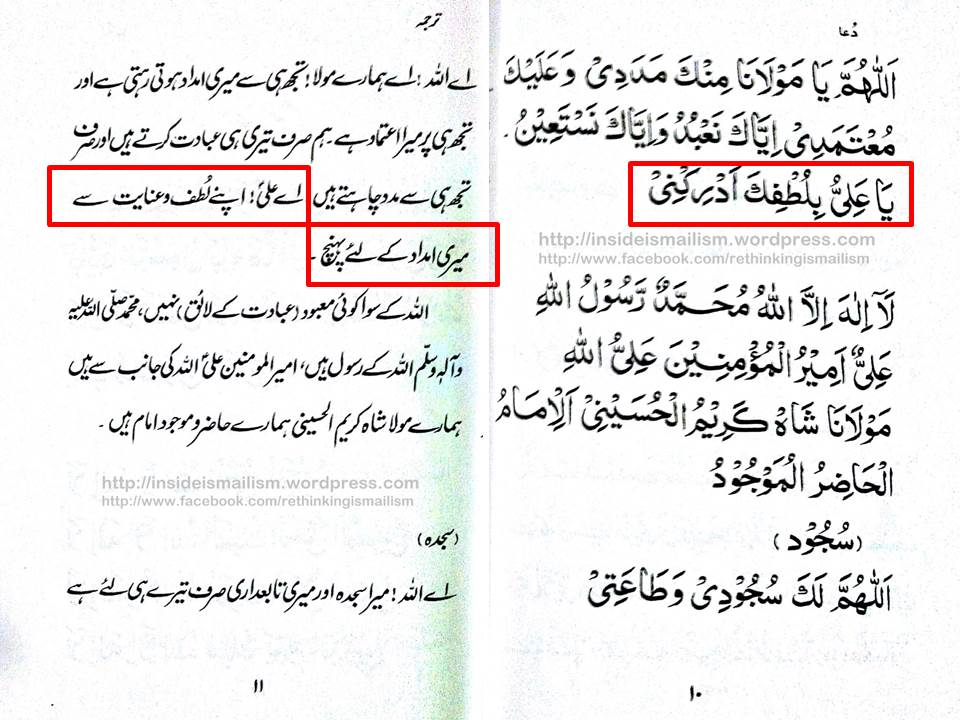

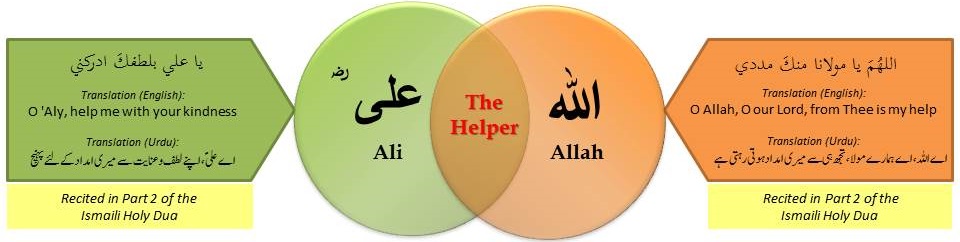
This establishes the second component of the Ismaili Trinity where instead of Allah (swt), Ali (ra) is invoked for help by the worshiper during the Ismaili Holy Dua, which can be illustrated as follows:

2.3 Triple Invocation #3 (of 3): Invoking Hazar Imam or Aga Khan
In the same Ismaili Holy Du’a in Unit 5 the Ismaili worshiper says with his hands raised:
يا امامَ الزَّمان يا مولانا انتَ قُوَّتِي و انت سَندي وعليكَ اتكالي
يا حاضر يا موجود يا شاه كريم الحسيني، انتَ الامامُ الحقُ المُبِيْنُ
Transliteration:
ya imamaz-zaman, ya mawlānā, anta quwwati , wa anta sanadi, wa’alaykat tlkali,
ya hadir, ya mawjud, ya Shah Karim al husayni, anta al imam ul haqq ul mubin
Translation (English):
O Imam of the time, O our Lord, Thou art my strength and Thou art my support and on Thee I rely
O present O living, O Shah Karim al-Husayni, Thou art the true manifest Imam.
Translation (Urdu):
اے امامِ زمان، اے ہمارے مولا، توہی میری قوت ہے اور تو ہی میرا سہارا ہے اور تجھ ہی پر میرا توکل ہے
اے حاضر، اے موجود ، اے شاہ کریم الحسینی، تو ہی برحق اور ظاہر امام ہے
Here is an excerpt from the Ismaili Dua book as an evidence of the above:
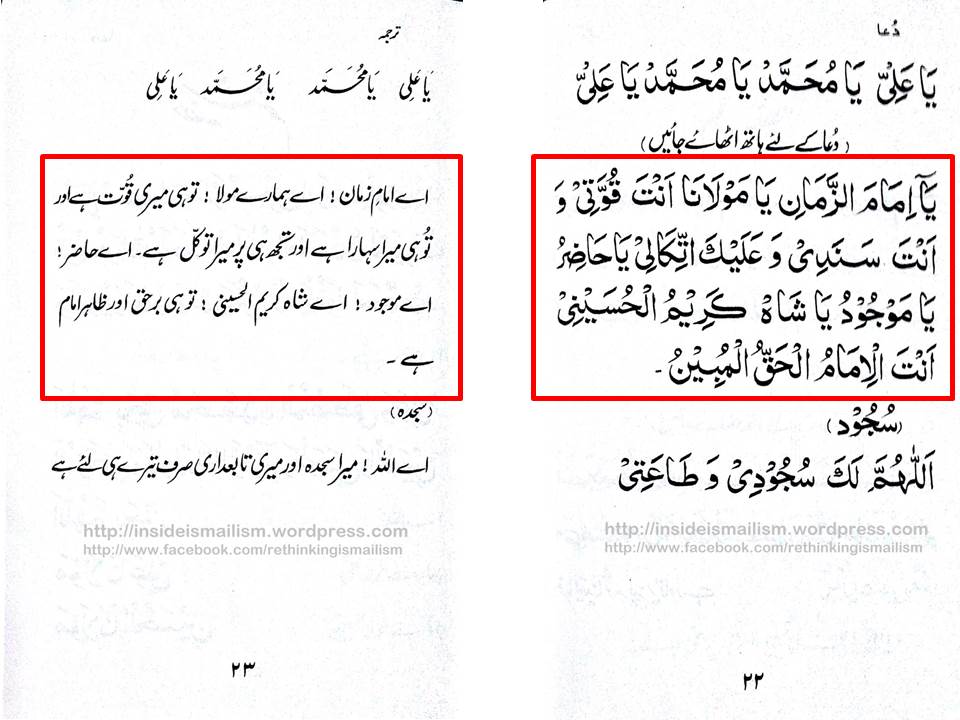
Therefore here, the Imam az-Zaman (or the Imam of the present time, which is the Aga Khan) is invoked during the Ismaili Holy Du’a:
Hazar Imam is given the title of Mowlana – same as the name given to Allah in the second unit of the Ismaili Dua (illustrated and described above in Section 2.1).
Hazar Imam is asked for strength and support (help) – same as it was sought from Ali (ra) in the second unit of the Ismaili Dua (illustrated and described above in Section 2.2)
These three invocations complete the Ismaili Trinity in the form of Allah (swt), Ali (ra) and the Hazar Imam – all of who are addressed as lord and asked for help, which can be illustrated as follows:
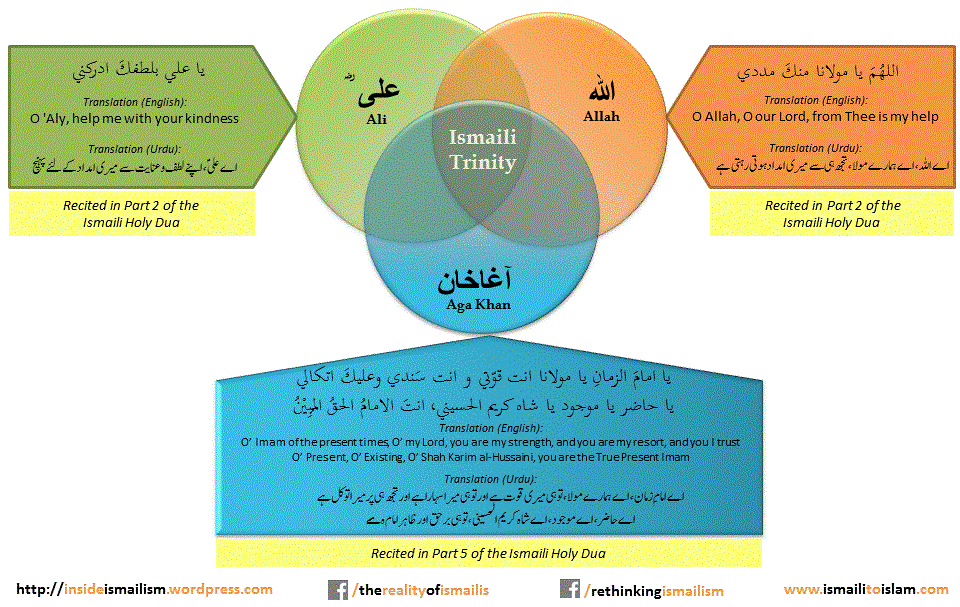
3. Conclusion
Allah says in the Quran in Surah al-Jinn Chapter 72, Verse 18:
وَأَنَّ الْمَسَاجِدَ لِلَّهِ فَلَا تَدْعُوا مَعَ اللَّهِ أَحَدًا
Transliteration:
Wa ‘Anna Al-Masājida Lillāhi Falā Tad`ū Ma`a Allāhi ‘Aĥadāan
Translation (English):
And that the masjids are for Allah, so do not invoke with Allah anyone.
Translation (Urdu):
ور یہ کہ مسجدیں صرف اللہ ہی کے لئے خاص ہیں پس اللہ تعالیٰ کے ساتھ کسی اور کو نہ پکارو
In spite of clear prohibition of worshiping anyone other than Allah according to the Islamic creed and according to the Quran, this ritual of offering prayers is repeated daily in the Ismaili Jamatkhanas (or Ismaili Centers as they are called in the west). When the Ismaili worshiper is reciting this Holy Dua, he is directing it towards a single deity like Muslims do. Muslims, however invoke, praise and worship Allah whereas in the Ismaili Holy Dua, Ismailis invoke and praise Ali (ra) and Hazar Imam. As a result of this trinity, the differentiation between Allah, Ali (ra) and Hazar Imam is subconsciously removed. A normal Ismaili assumes Hazar Imam to have divine powers. Author Mihir Bose writes in book The Aga Khans:
In 1967 a young man, just turning thirty, visited a small Asian community in Iringa in Tanzania. The young man had a most curios background; his mother was English, his father half Italian and he himself was one of the richest men in the world. He had arrived in Iringa, and its small community of 800-odd Asians, as part of his religious duties. Iringa is one of those Tanzanian places which nobody has ever heard of, and no celebrity ever visits. But this young man’s visit was so important that a special extension was built onto the house in which he was to live. This was fitted out in what locals called ‘the Western style’, meaning a bathroom with a proper toilet and a bath tub. Some time during his stay in Iringa the young man had a bath in the bath tub. This would hardly be worth mentioning except that long after the young man had left Iringa, the water that he had used for his bath was saved and bottled. The Asian community in Iringa believed the young man was God and they were happy to buy bottles of the young man’s bath water and preserve it in their homes as a sure mark of their God.
When Willi Frischauer, during writing of his book on the historical account of Karim al Hussaini and his ancestors, spoke to a young Ismaili graduate in an important position in a Commonwealth organization whom he asked to tell the Aga Khan of their conversation, the student replied: ‘Of course, of course – but, being the Imam, he will know anyway.’
Thousands of Ismailis around the world today are living testimony of the belief that their Hazar Imam possesses divine powers of listening to the supplications of Ismailis wherever they speak to him in whatever language they invoke him and granting them their wishes. This is the reason that at the end of every Holy Dua in the Jamatkhana, the following supplications, among many more, are made all across the world calling the Hazar Imam, while the Aga Khan has no worldly possible means of hearing these:
Ya nur mowlana Shah Karim al Husaini Hazar Imam, forgive the sins of the Jamaat
یا نور مولانا شاہ کریم الحسینی حاضر امام جماعت کے کُل گناہ معاف فرما
Ya nur mowlana Shah Karim al Husaini Hazar Imam, give ease to the Jamat in their difficulties
یا نور مولانا شاہ کریم الحسینی حاضر امام جماعت کی کُل مشکلیں آسان فرما
Ya nur mowlana Shah Karim al Husaini Hazar Imam, bless the Jamat with your spiritual glimpse
یا نور مولانا شاہ کریم الحسینی حاضر امام جماعت کو اپنا نورانی دیدار نصیب فرما
May Allah guide the Ismailis to take their guidance from the Quran rather than anything else, and enable them to seek help from Allah rather than anyone else. Amen.