
One thing which Muslims in general do not realize about Ismāʿīlīs is that how different is Ismāʿīlīsm as compared to ’Islām. Here are 10 shocking facts which Muslims have never been told about the Ismāʿīlī prayer (also known as Holy Du’ā) which the Ismāʿīlīs pray as a substitute for the Muslim ṣalāt.
1. No adhan, no wuḍūʼ before the Ismāʿīlī prayer
Allāh says in the Qurʼān:
O you who have faith! When the call is made for prayer on Friday, hurry toward the remembrance of God, and leave all business. That is better for you, should you know. And when the prayer is finished, disperse through the land and seek God’s grace, and remember God greatly so that you may be felicitous.al-Qurʼān, 62:9-10
The call for prayer (adhān) can never be heard from a Ismāʿīlī Jamatkhana. The reason is simple: Ismāʿīlīs do not recite the obligatory prayer (Arabic: aṣ-ṣalāh Persian: namāz), at all. Instead, Ismāʿīlīs pray something called the Holy Du’ā, twice a day – one in the morning and the later two combined in the evening after business hours – regardless of the sunrise and sunset timings.

Ismāʿīlī jamatkhanas are closed from around 6 a.m. in the morning till around 6 p.m. in the evening, notably at the times of ṣalāt aẓ-ẓuhr – even on the Fridays when Muslims around the world offer ṣalāt al-Jumuʿah.
Ismāʿīlīs also do not perform the obligatory ablution or wuḍūʼ before Holy Du’ā, as they consider themselves esoteric or bāṭini Muslims who are absolved of all physical rituals – specially cleaning and fasting. Hence, Ismāʿīlīs neither perform wuḍūʼ, nor do they fast during Ramaḍān.
2. No entry for Muslims in Ismāʿīlī Jamatkhana during prayers
Where Ismāʿīlīs regard themselves as bāṭini Muslims, they regard other Muslims – both Shia and Sunni – as zāhiri or shariyati Muslims. They say that for a shariyati Muslim, the physical rituals are of primary significance and of greater consequences than the inner most spiritual ones. Ismāʿīlīs are advised by their elders to hide their inner practices and secret beliefs, and not to discuss their faith with “other” Muslims. Muslims are also not allowed to enter Ismāʿīlī prayer halls – especially during the timings when prayers are being held there. The excuse which Ismāʿīlīs are fed by their missionaries is that the “other” Muslims are not mature enough to comprehend or digest the Ismāʿīlī philosophy of mārfat (معرفت). Ismāʿīlī leadership is apprehensive that their bāṭini Ismāʿīlī community may be labeled as apostates if they were to engage in discussions, or be open about Ismāʿīlī beliefs.
3. Ismailis do not face the Qibla during their prayer
Allāh says in the Qurʼān:
قَدْ نَرَىٰ تَقَلُّبَ وَجْهِكَ فِي السَّمَاءِ فَلَنُوَلِّيَنَّكَ قِبْلَةً تَرْضَاهَا فَوَلِّ وَجْهَكَ شَطْرَ الْمَسْجِدِ الْحَرَامِ وَحَيْثُ مَا كُنتُمْ فَوَلُّوا وُجُوهَكُمْ شَطْرَهُ وَإِنَّ الَّذِينَ أُوتُوا الْكِتَابَ لَيَعْلَمُونَ أَنَّهُ الْحَقُّ مِن رَّبِّهِمْ وَمَا اللَّهُ بِغَافِلٍ عَمَّا يَعْمَلُونَ
Translation:
Indeed, We see you ˹O Prophet˺ turning your face towards heaven. Now We will make you turn towards a direction ˹of prayer˺ that will please you. So turn your face towards the Sacred Mosque ˹in Mecca˺—wherever you are, turn your faces towards it. Those who were given the Scripture certainly know this to be the truth from their Lord. And Allāh is never unaware of what they do.
al-Qurʼān, 2:144
Ismāʿīlīs subscribe to the belief that “Allāh is present everywhere” and hence argue that one does not have to face a particular direction when praying. Some of the recently constructed multimillion dollar Jamatkhanas in North America are so built that the main congregation has their backs facing Mecca. This might not necessarily be a deliberate rejection of sharaii requirements, but it is noteworthy that these “back towards the Kaaba” designs of modern Ismāʿīlī Jamatkhanas have accepted and upheld by Aga Khan.
In fact, inside the Ismāʿīlī prayer hall, the person – male or female – leading the prayer faces the congregation during their Holy Du’ā – so that even when prostrating, the person leading the prayer and the participants of the congregation are prostrating to each other.
4. The Ismāʿīlī prayers are qiyām-less and rukūʿ-less
More than a billion Muslims around the world follow the Quranic commandments standing in rows after rows, facing the direction of the kaʿbah, and then performing ruku and sujood as taught by the Prophet (pbuh) and as commanded by Allāh in the Qurʼān. For example:
وَأَقِيمُوا الصَّلَاةَ وَآتُوا الزَّكَاةَ وَارْكَعُوا مَعَ الرَّاكِعِينَ
Translation:
Establish prayer, pay zakāh, and bow down with those who bow down.
al-Qurʼān, 2:43
Also,
يَا أَيُّهَا الَّذِينَ آمَنُوا ارْكَعُوا وَاسْجُدُوا وَاعْبُدُوا رَبَّكُمْ وَافْعَلُوا الْخَيْرَ لَعَلَّكُمْ تُفْلِحُونَ
Translation:
O believers! Bow down, prostrate yourselves, worship your Lord, and do ˹what is˺ good so that you may be successful.
al-Qurʼān, 22:77
Ismāʿīlīs on the other hand reject all evidences from Qurʼān and ḥadīth and perform their prayers – from the beginning to the end – in a cross-legged position. Their “Holy Du’ā” is devoid of any qiyām or any rukūʿ. This method of the Holy Du’ā has been ordained personally by Aga Khan and is rigidly adhered to.
5. Ismailis glorify ʿAlī and his sword during their prayer
While Muslims praise and glorify Allāh in their prayers, Ismāʿīlīs, glorify ʿAlī bin ʾAbī Ṭālib and his sword in their prayers. Their Holy Du’ā contains the following phrase:
لا فتى إلا علي لا سيف إلا ذو الفقار
Transliteration:
Lā fatā ʾillā ʿAlī; lā sayf ʾillā Ḏūl-Fiqār
Translation (English):
“There is no hero like Ali; There is no sword like Dhul-Fiqar”
Translation (Urdu):
علی جیسا کوئی جوان نہیں اور ذوالفقارجیسی کوئی تلوار نہیں۔
The question is, what is the relevancy of this phrase during what Ismāʿīlīs call their “prayer”? Are Ismāʿīlīs trying to communicate to Allāh about ʿAlī and who ʿAlī was?
6. Ismāʿīlīs wish each other “May you have the glimpse of Aga Khan” (Shāh jo Dīdār) as a part of their prayer
At the end of the prayer, a Muslim would turn his face to either side saying “Assalamualaykum wa rahmatullah”. However, at the end of their du’ā, every Ismāʿīlī is required to shake hands with the person sitting next to him or her – whether that person is of the same or the opposite gender – and utter to them “Shah jo Dīdār” which literally means “(May you have the) glimpse of the Shah (Karim Aga Khan)”. This refers to the spiritual glimpse and not the physical glimpse of Aga Khan. Having a “Noorani Dīdār” of Aga Khan before death is the highest aspiration which a devout Ismāʿīlī harbors in his heart.
I have met hundreds of Ismāʿīlīs who have tried their level best to have that “glimpse”, but never met one who has claimed to have actually experienced that “glimpse”.
7. Male or Female of any age, can lead Ismāʿīlī prayers in Jamatkhana
An individual of any gender and of any age, who has memorized the Ismāʿīlī Holy Du’ā, can lead the prayer – or become a “paish imām” – in the Ismāʿīlī Jamatkhana. This individual, irrespective of his or her age, would join the rank of the other title holders for the day and face the congregation to lead the prayers.
Multicolored photographs of Aga Khan, which only a couple of decades ago used to hang from all the four walls and the pillars of the prayer halls of the Ismailis Jamatkhanas, are now placed on the side walls.
There are a few occasions when the special “guided tours” of the prestigious multimillion dollar modern Jamatkhanas are conducted. Usually these tours are for State dignitaries and the media, but are conducted strictly outside of the prayer hours. The photographs of Aga Khan are swiftly removed by volunteers while these tours are conducted and put back on as soon as these tours are concluded. This is done to make sure that no one has the impression that Ismāʿīlīs are prostrating towards the photographs of Aga Khan or worshiping the Aga Khan, as for the Ismāʿīlīs, the Ismāʿīlī “inner values” are inexplicable to these “outsiders” due to the outsiders’ “lack of knowledge”.
These are few of the reasons why admission to the Ismāʿīlī Jamatkhanas is restricted. These restrictions equally apply to members of the Muslim ummah. These “Aga Khani Ismāʿīlīs” call themselves Muslims, but when it comes to standing shoulder to shoulder with the rest of the ummah for ṣalāt, they part company and sit down in a secluded quarter and recite their own supererogatory prayer.
8. The Ismāʿīlī Holy Du’ā was declared “nonessential” by the Ismailia Council Pakistan in Sindh High Court
The following declaration was made in Sindh High Court by the President and Secretary of the Ismailia Council Pakistan:
“Inherent right of devolution of ownership of Jamatkhanas (is) in the Imam. Jamatkhanas are not dedicated as masjids (mosques) … (they are) additional places for religious practices, other than masjids, for supererogatory prayers.”
The synonyms for “supererogatory” are superfluous, nonessential or uncalled for according to the Oxford dictionary.
Such a declaration before a court of law demonstrates that Ismailia Council Pakistan accepts that masājid are the houses of Allāh, whereas Ismāʿīlī Jamatkhanas are the houses of the Aga Khan. The prayers that are recited in the houses of Allāh are the farḍ (obligatory or compulsory) prayers, whereas the Holy Du’ā which is recited in the Ismāʿīlī Jamatkhana are supererogatory (superfluous or nonessential) supplications which are commanded by the Aga Khan.
9. Aga Khan never visits Jamatkhana during the Ismāʿīlī prayer timings and has never led the Ismāʿīlī prayer
Every Ismāʿīlī entering the prayer area of the Jamatkhana is asked to remove his or her shoes. However when Aga Khan visits the prayer hall to conduct various religious ceremonies – such as forgiving sins of his followers – he does it with his shoes on. The ritual of forgiving sins is done by Aga Khan by sprinkling Holy Water on the faces of whichever of the followers pay enough money, and whispering to them in their ears: “Your sins are forgiven.”. I know this with certainty since he had whispered that in the ears of my wife and me.
Interestingly, Aga Khan never ever visits the prayer area during prayer timings so that he never has to either lead prayers, or pray along with the rest of his followers.
Several written requests from the Ismāʿīlī leaders an the general Ismāʿīlī public have been made to Aga Khan in the last two decades to reintroduce the ’Islāmic ṣalāt which was originally being recited four to five generations ago by ancestors of the present-day Ismāʿīlīs. But all these requests remain unacknowledged to this day, which can be translated as “declined”.
10. Ismāʿīlī Holy Du’ā was originally introduced in Africa with sujood (prostration) to Aga Khan and not Allāh
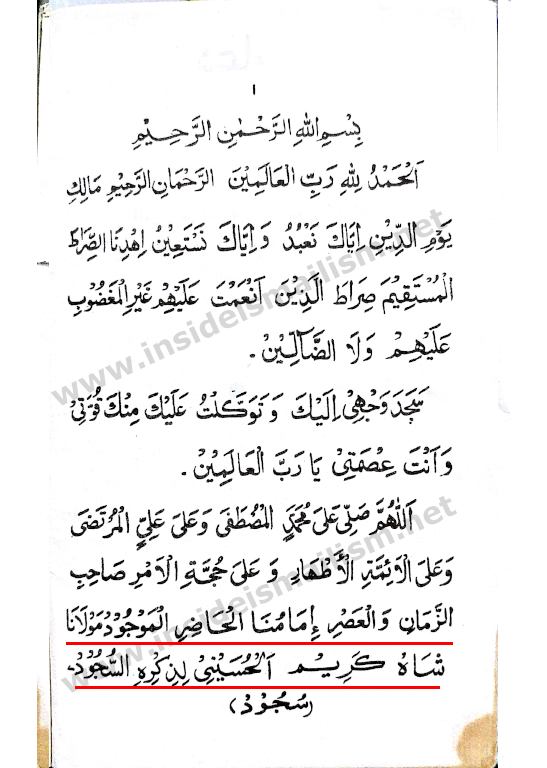
Over the century-and-a-half, the Islamic ṣalāt and the šahādah have not been revised. However, for the Ismāʿīlīs within half-a-century, the Ismāʿīlī Holy Du’ā and the šahādah have each been revised thrice. Originally, as recent as the early days of Karim Aga Khan, the Holy Du’ā included prostration to Karim Aga Khan.
The Gujrati Du’ā, was formulated and officially pronounced by the farmān of Aga Khan III. The present Aga Khan introduced the new Arabic Holy Du’a in Eastern Africa. Each part (also called paat, which is equivalent to a unit of prayer, or rakʿah of the Islamic prayer) of this new Holy Du’ā had the following ending:
الامام الحاضر الموجود لذكره السجود
Transliteration:
al¬Imāmul hadir-il maujood li dhikri-his sujood
Translation (English):
“The present Imām, to whose name prostration is due.”
Translation (Urdu):
حاضر اور موجود امام، جن کے ذکر پر سجدہ ہے۔
Here are scanned pages from the Ismaili Du’ā book which has now been abandoned:
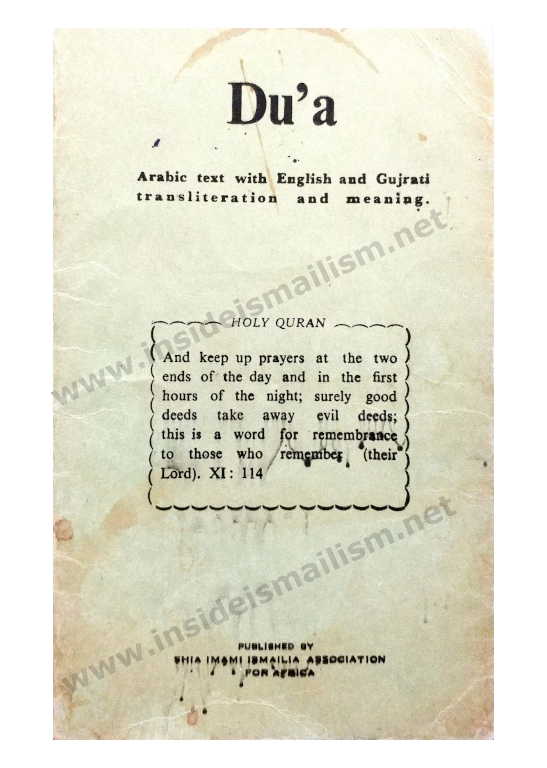
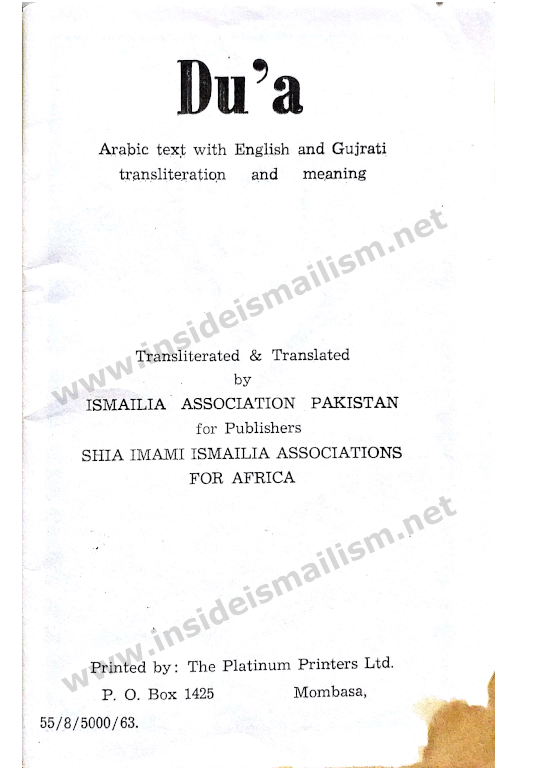
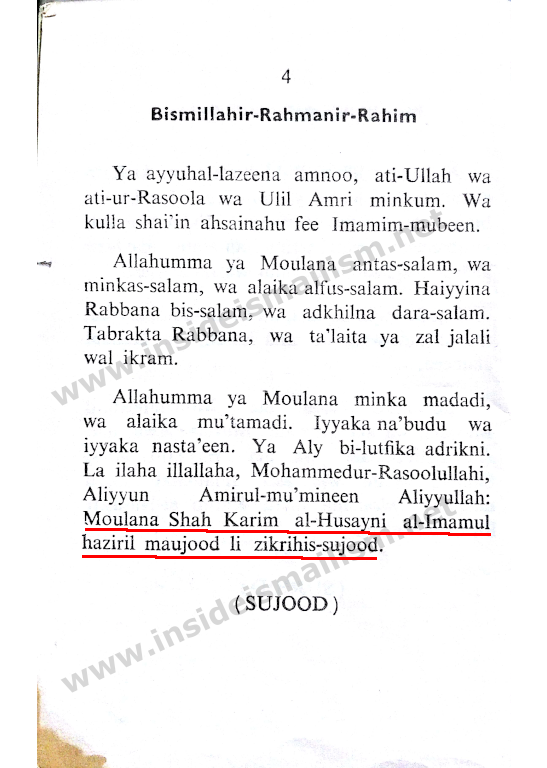
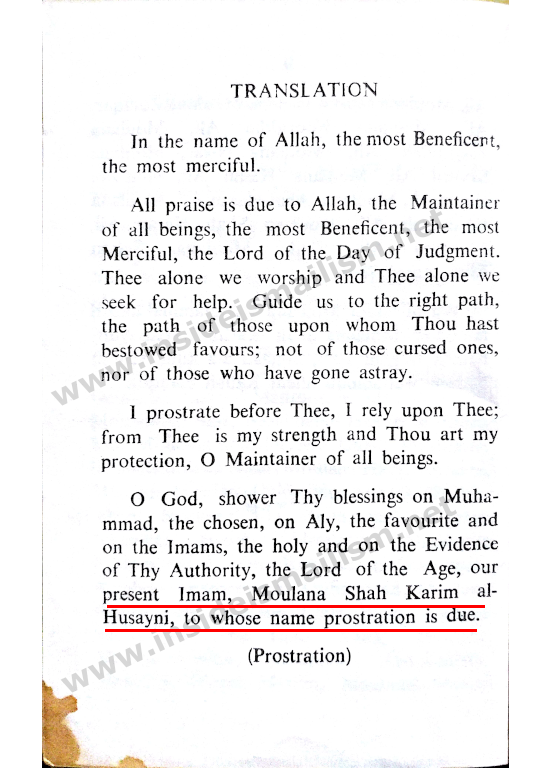
When the same new Holy Du’ā was introduced in the Islamic Republic of Pakistan, the above-mentioned phrase was changed to read:
اللهم لك سجودي و اطاعتي
Transliteration:
Alla-humma laka sujoodi wa ta’ati
Translation (English):
“O Allah, to you is my prostration.”
Translation (Urdū):
اے اللہ، میرا سجدہ اور میری تعبداری تیرے ہی لیئے ہے۔
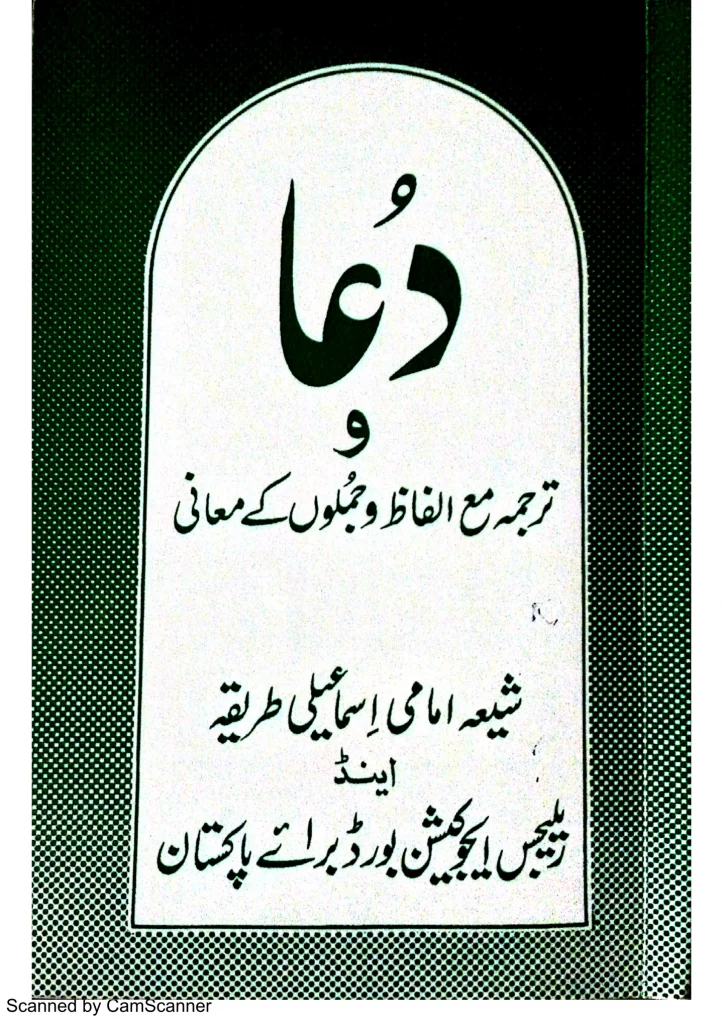
Here are scanned pages from the new Ismaili Du’ā book which is in use today:
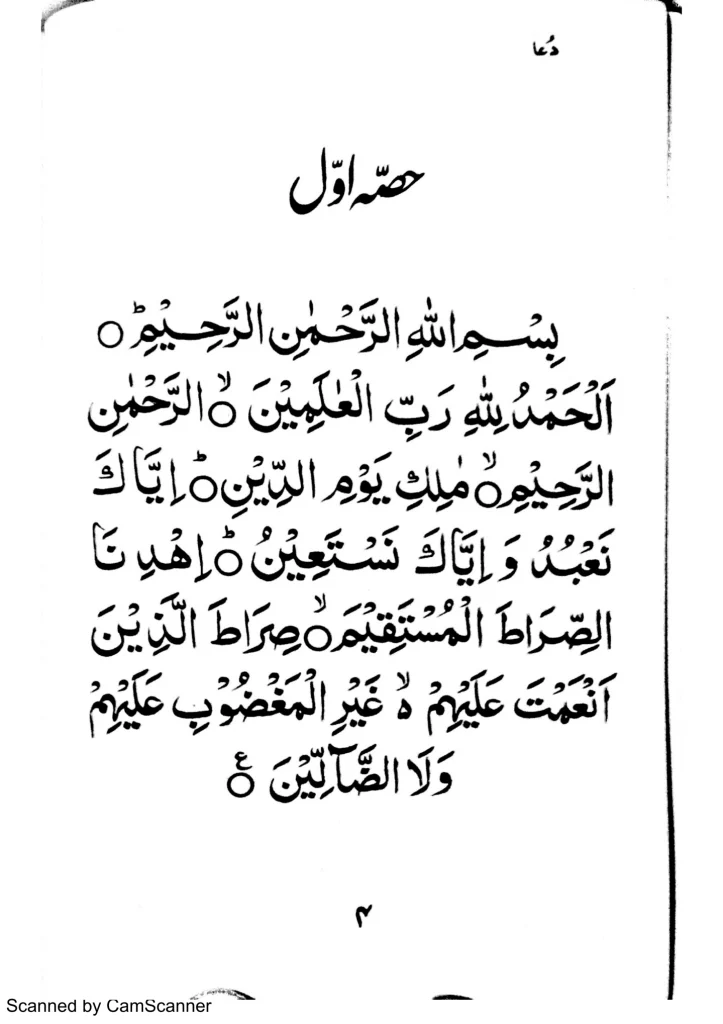
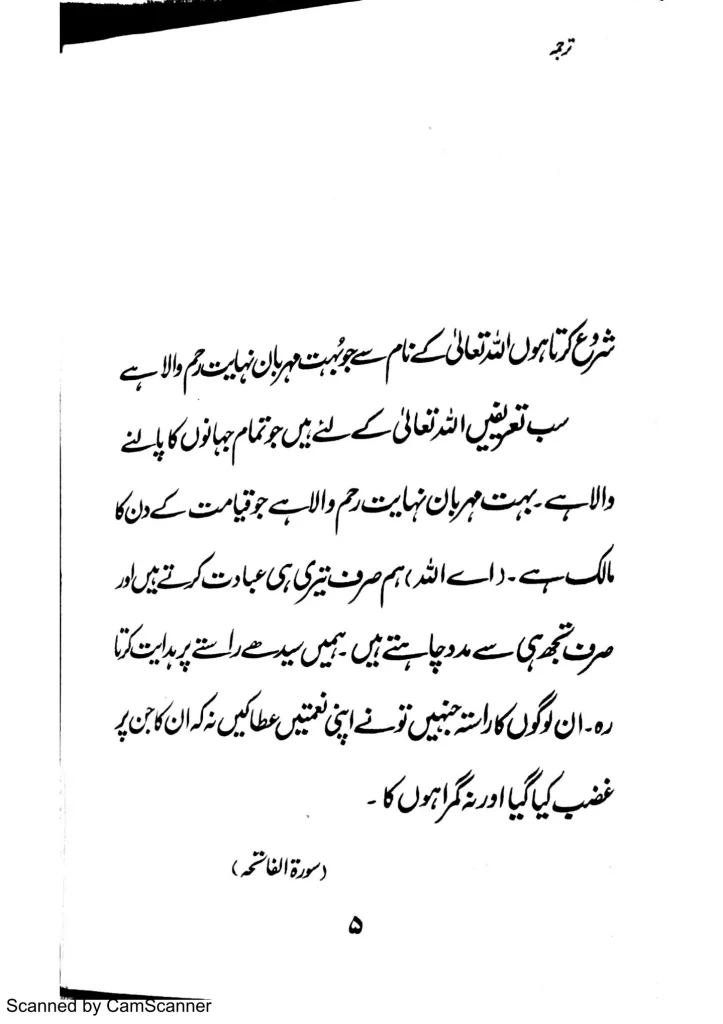
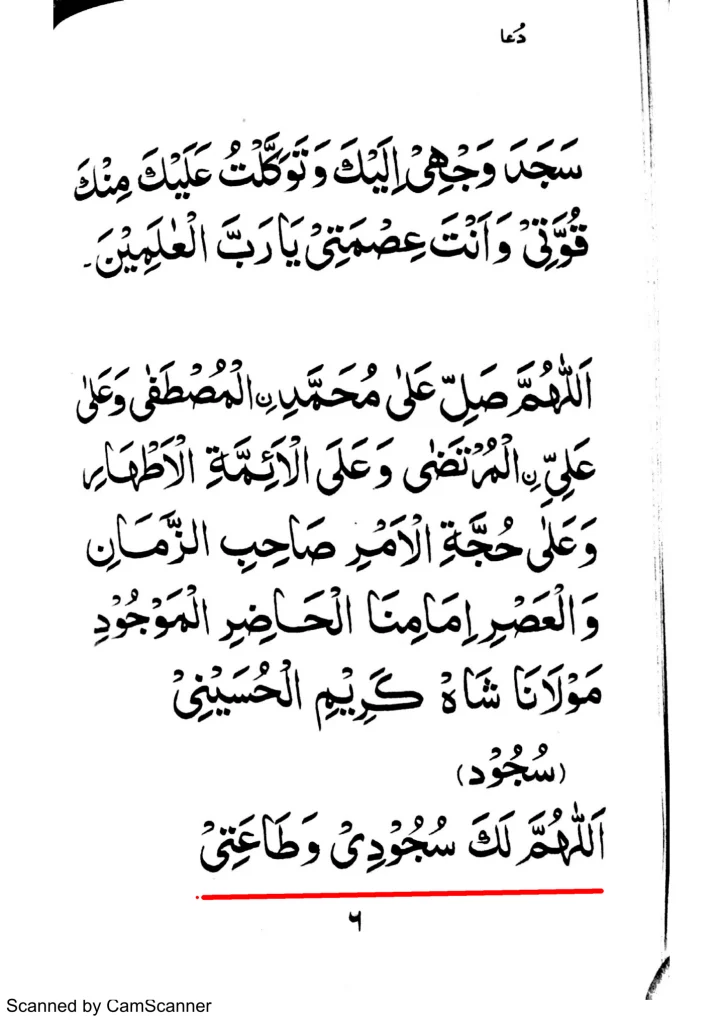
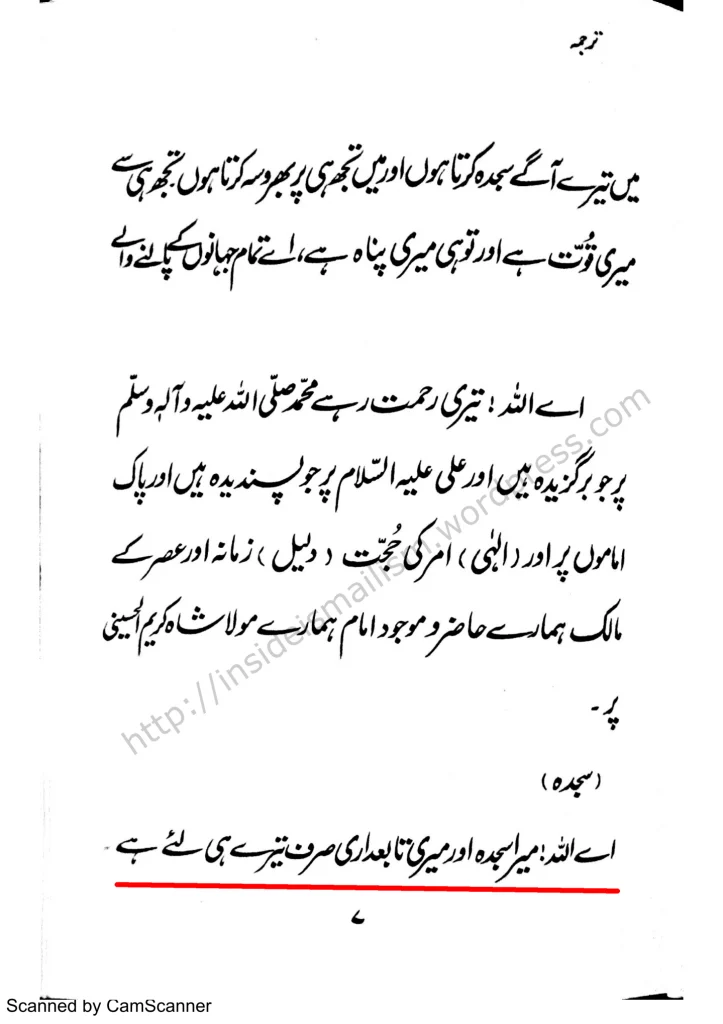
Obviously this change was under the fear of being exposed by the Muslim scholarship in Pakistan who according to the Ismāʿīlīs, lack the knowledge and true understanding of the “inner Ismāʿīlī gnostic” which is not easy to comprehend for the “shariati” people.
Later on, the Holy Du’ā was standardized globally and later editions of the Holy Du’ā all contain the phrase “Alla-humma laka sujoodi wa ta’ati”. Ismāʿīlīs in general are unaware of the corrupt origins of their Holy Du’ā which still contains partial and scotch-taped verses from the Qurʼān.
by Akbar Khoja
For more information:
– Follow Rethinking Ismailism page on Facebook by clicking here.
– Discuss on Ismailism and Islam Discussion Group on Facebook by clicking here.
– Visit http://www.insideismailism.net for English articles, and download books in English, Urdu, Arabic and Gujarati by clicking here.
– Visit agakhaniyat.blogspot.com for Urdu articles by clicking here.